Senior engineers who stay. That's the whole difference.
Most software firms rotate developers through your project like a revolving door. We do the opposite. When you engage Caxy, you get a dedicated team of senior engineers who learn your domain, your codebase, and your business goals - and stay with you for the life of the engagement.
It's Not a Technology Problem. It's a Problem Problem.
The industry has a 92% failure rate - and it's not because developers can't code. Projects fail because teams build the wrong thing. They skip the hard work of understanding the actual customer need, rush into development, and deliver software nobody asked for. Then they blame the timeline, the budget, or the technology. We've shipped over 100 production platforms in 25 years. The reason we succeed isn't that we write better code -- it's that we start with the right question. Before we build anything, we work with you to identify the real problem your customers have, validate that the solution you're imagining actually solves it, and define exactly what "done" looks like. That's the work most firms skip. It's the work that determines whether your project joins the 92% or the 8%.
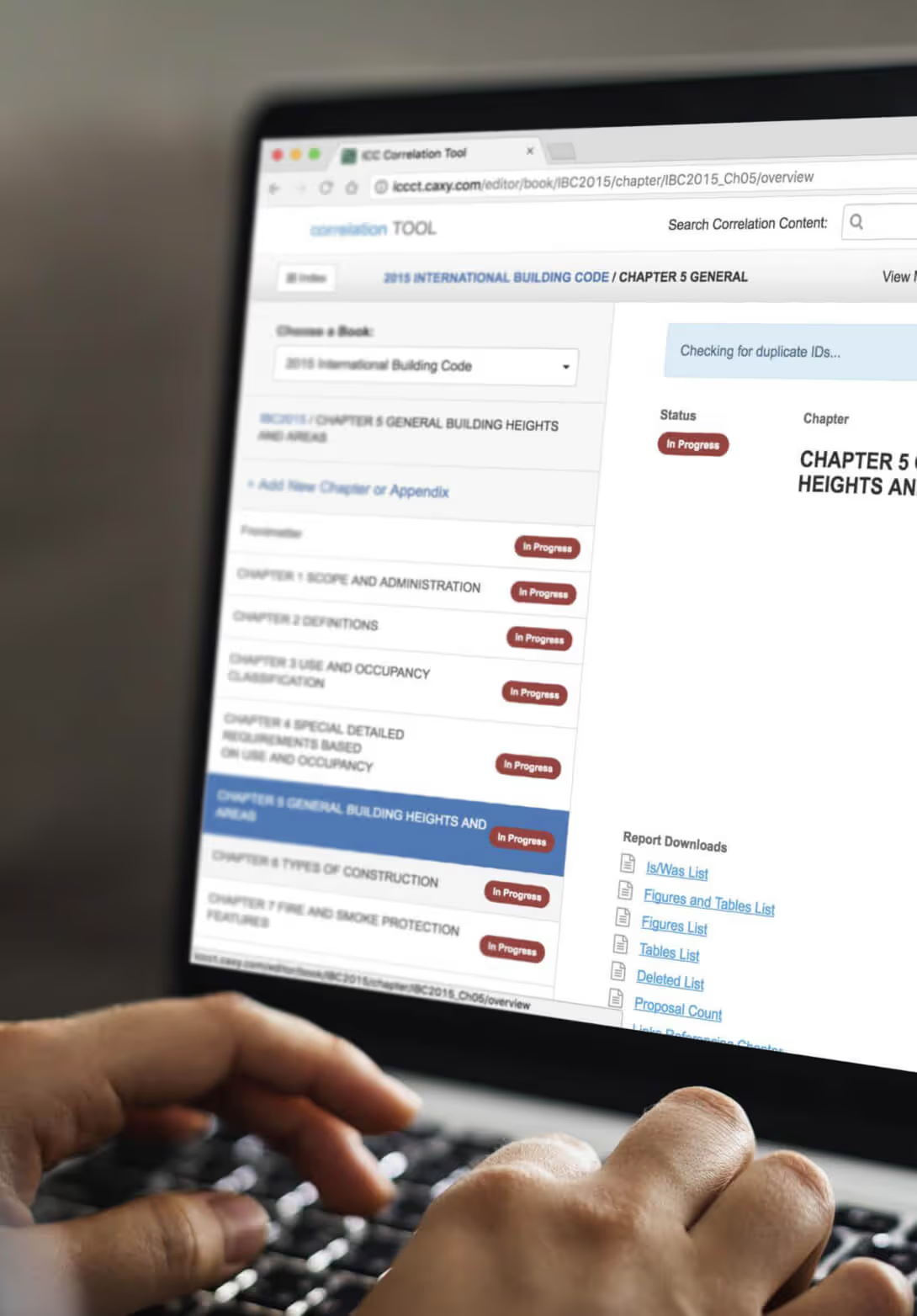
















You've been burned by the bait-and-switch. The senior architect pitches the deal, then juniors build your software.
You've seen this movie before. A polished team shows up for the pitch. Senior architects draw impressive diagrams on the whiteboard. Then the contract gets signed and suddenly you're working with developers who just graduated from a bootcamp. The architect who "designed" your system moves on to the next sales call. Your project manager becomes a translator between you and an offshore team you've never met. Six months later you have a codebase nobody understands, a team that can't answer questions about their own code, and a budget that's doubled. This is the default experience with most software firms. We built Caxy specifically to be the opposite.



Three ways to start. A 30-minute discovery call where you describe the problem and we tell you honestly if we're the right fit. A $50K Game Changer Assessment where our team maps your technology landscape and delivers a prioritized roadmap with dollar figures on every finding. Or a scoping sprint where we define the architecture, estimate the cost, and start writing code within weeks. Every engagement runs in 2-week sprints with a working demo at the end of each one. You see progress every two weeks - not a big reveal at the end.
Most firms start with a sprint plan. We start with a question: what problem are we actually solving? Before a single line of code is written, we validate assumptions, interview users, and pressure-test the business case. Then we build in 2-week cycles with a working demo every time. No big reveals. No surprises. No wasted months. This is why our projects ship on time when 92% of the industry doesn't. The secret isn't better engineers - though ours are exceptional. It's that we refuse to build the wrong thing.
What to know about hiring a dedicated software development team
A dedicated development team is a self-contained unit - architects, developers, QA, and project management - that takes ownership of outcomes, not just hours. Staff augmentation adds individual contractors to your existing team. Dedicated teams are better for projects requiring end-to-end accountability. Augmentation works when you need specific skills to supplement an established team.
Dedicated senior development teams in the US typically cost $80K-$200K per month depending on team size and composition. A typical Caxy team of 3-5 senior engineers runs $120K-$180K monthly. This is higher than offshore rates but delivers lower total project cost because senior engineers write production-quality code the first time, reducing the rework cycles that inflate offshore project budgets by 40-60%.
Ask three questions: Can I meet the actual engineers who will work on my project? What is the average tenure of your developers? Can you show me production systems you built 3+ years ago that are still running? Firms that rotate developers, hide behind project managers, or can only show recent work are signaling problems. Engineers who stay and platforms that last are the real proof.
Onshore teams work in your timezone with native English fluency and cultural alignment. Offshore teams offer lower hourly rates but add coordination overhead, communication gaps, and timezone delays. For complex business logic and stakeholder-heavy projects, onshore teams consistently deliver faster total outcomes. The hourly rate difference disappears when you account for revision cycles and miscommunication costs.
A well-organized dedicated team can begin productive development within 2-3 weeks. The first 1-2 weeks focus on codebase onboarding, architecture review, and workflow integration. By week 3, the team is contributing to sprint goals. Full velocity is typically reached by week 4-6. Teams with high turnover never reach full velocity because they're perpetually re-learning.
At Caxy, this is rare - our 5+ year average tenure means turnover is well below industry norms. When it does happen, knowledge transfer is built into our practices: pair programming, documented architecture decisions, comprehensive code reviews, and shared codebase ownership mean no single person holds critical knowledge. The remaining team continues without disruption.
Daily standups, shared project boards (Jira/Linear), bi-weekly sprint demos with stakeholders, and a dedicated technical lead as your primary contact. You communicate directly with the engineers building your software - not an account manager translating requirements. This directness eliminates the telephone game that derails most agency relationships.
Yes. About half our engagements involve embedding alongside existing internal teams. We match your SDLC - same sprint cadence, same tools, same code review standards. Our engineers submit PRs to your repo and participate in your standups. The goal is seamless integration, not a separate workstream that needs to be merged later.
Core stack: React, Next.js, Node.js, Python, TypeScript, and AWS. Mobile: React Native and Swift. AI/ML: Claude, OpenAI, custom models, RAG systems. Infrastructure: Terraform, Docker, Kubernetes, CI/CD pipelines. We are an AWS Advanced Partner with 9 certifications. We also integrate with legacy systems.
Yes. 100% IP and source code ownership from day one. No licensing fees, no proprietary frameworks, no lock-in. We build on open-source technologies and standard cloud infrastructure specifically so you are never dependent on us. Your codebase is yours to take to any team at any time. Most clients stay because we deliver value - not because they're stuck.






.avif)