Website Development in Chicago -- Custom Websites That Convert, Integrate, and Last
WordPress, Webflow, and ContentStack are great platforms -- when they are configured correctly. But when your business needs a website that integrates with your CRM, processes real transactions, and does more than look good on a screen, you need custom engineering. Caxy has been building websites for Chicago businesses since 1999. AI-optimized at every step. Senior US engineers. No templates
Chicago websites that work as hard as your sales team
Most business websites are digital brochures that cost money and generate nothing. We build custom websites that convert visitors into customers, integrate with your backend systems, and keep performing for years - not months.
Custom Website Development
From architecture to launch in 8-12 weeks. Built on AWS with CI/CD, monitoring, and automated testing. Not a WordPress theme with your logo on it.**Website Redesign and Migration**
Your current website was built for a different era. We redesign without losing your SEO equity or breaking your integrations. Parallel environments, zero-downtime migration.
CRM and ERP Integration
Your website should feed data directly into Salesforce, NetSuite, HubSpot, or whatever you run. We build custom integrations so your website works with your business, not alongside it.
Ecommerce and B2B Platforms
Custom ecommerce for businesses that outgrew Shopify. B2B platforms with catalog complexity, custom pricing, and multi-warehouse fulfillment.
Content Management
Headless CMS, Webflow, or fully custom -- whatever gives your marketing team control without requiring a developer for every change.















Templates work until they do not
WordPress and Webflow are excellent platforms. We use Webflow ourselves and help clients optimize their template sites for performance, SEO, and AI search visibility. A well-configured template site can handle most brochure-style needs.But here is when you need custom:
- Your website needs to integrate with your CRM, ERP, or proprietary systems
- You need custom business logic - pricing engines, configurators, user portals
- Your traffic requires real scalability - not a shared hosting plan
- You need HIPAA, SOC 2, or PCI compliance baked into the architecture
- Your current site has been rebuilt twice already and still does not do what you needIf that sounds familiar, you need an engineering team, not a web designer.



Harbor Capital Advisors - PDF to real-time dataInvestment firm with a PDF-heavy legacy site where investors had to call someone to get fund data. We replaced it with real-time interactive data and mobile-first design. Institutional and individual investors can now self-serve.
tastytrade - Media streaming at scaleWe built the media streaming site and content platforms for this Chicago-based financial media company. The company was later acquired by IG Group for over $1 billion.
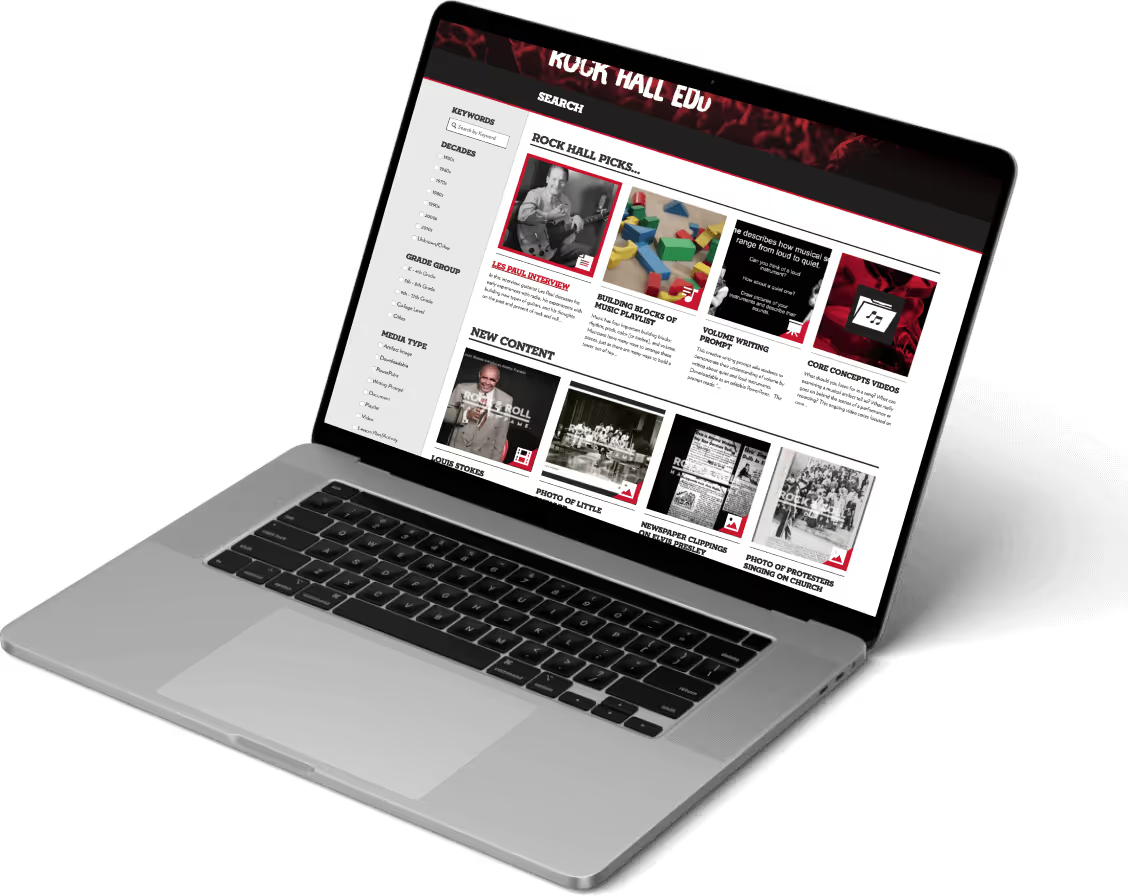
Rock and Roll Hall of Fame - Modern search experienceModernized the digital learning experience for one of America's most iconic cultural institutions. Modern search, mobile-first, performance-optimized.
Best Money Moves - SaaS platformBuilt an award-winning financial wellness platform from scratch. Mobile apps, employer dashboards, SOC 2 compliance.
Gartner reports that 80% of AI projects fail to deliver business value. The primary causes are poor data quality (40%), unclear business objectives (25%), and lack of integration with existing workflows (20%). Technical model issues account for only 15% of failures. Companies that invest in data preparation and process mapping before model selection have 3-4x higher success rates.
What businesses need to know about AI implementation
An AI readiness assessment examines five dimensions: data quality and accessibility, technical infrastructure, team capabilities, process maturity, and governance readiness. The output identifies which AI use cases are feasible with your current data, which require data remediation, and which are not viable. It prevents organizations from investing in AI initiatives their data cannot support, typically saving 6-12 months of misdirected effort.
Predictive AI analyzes historical data to forecast outcomes like demand, churn, or pricing optimization. Generative AI creates new content - text, images, code, and summaries - based on learned patterns. Most business ROI today comes from predictive AI applied to operations and generative AI applied to knowledge work. The right choice depends on whether your problem is "what will happen" or "create something new."
Enterprise AI implementations range from $100K for focused single-use-case projects to $2M+ for multi-system deployments. The cost breakdown is typically 40% data preparation, 25% model development and training, 20% integration and deployment, and 15% monitoring and governance. Caxy's Data Foundation engagement at $120K-$180K addresses the data preparation phase that determines whether the remaining investment succeeds or fails.
The five most common blockers are duplicate records across systems (present in 85% of organizations), inconsistent formatting and naming conventions, missing values in critical fields, stale data that has not been updated in months, and siloed data trapped in systems without API access. Fixing these issues typically takes 6-12 weeks and is the single highest-ROI investment in any AI initiative.
Sed tempor varius justo, ut placerat mi aliquet dapibus. Orci varius natoque penatibus et magnis dis parturient montes, nascetur ridiculus mus.
We implement retrieval-augmented generation that grounds AI responses in verified source documents, confidence scoring that flags low-certainty outputs for human review, structured output validation that checks AI responses against known constraints, and source attribution that lets users verify every claim. For customer-facing AI, we add human-in-the-loop review for responses below confidence thresholds and automated testing against known-good answer sets.
RAG is an AI architecture that retrieves relevant documents from your data before generating a response, grounding the output in factual sources rather than relying on the model's training data alone. It reduces hallucination rates by 60-80% compared to raw LLM responses. RAG requires a well-organized knowledge base with clean, current content - which is why data preparation is a prerequisite for effective RAG deployment.
Yes, with appropriate governance. We build AI systems that comply with HIPAA, SOC 2, GDPR, and industry-specific regulations by implementing audit trails, access controls, data residency requirements, and explainability features. Regulated industries require human-in-the-loop workflows for clinical or financial decisions, model versioning for reproducibility, and bias testing. These requirements add 20-30% to implementation costs but are non-negotiable.
RAG is an AI architecture that retrieves relevant documents from your data before generating a response, grounding the output in factual sources rather than relying on the model's training data alone. It reduces hallucination rates by 60-80% compared to raw LLM responses. RAG requires a well-organized knowledge base with clean, current content - which is why data preparation is a prerequisite for effective RAG deployment.
Production AI systems require model performance monitoring to detect accuracy drift, data pipeline maintenance to ensure input quality, prompt or model retraining as business context evolves, cost monitoring for API-based models, and security updates. Plan for 15-20% of the initial build cost annually for maintenance. Without active monitoring, AI systems degrade within 6-12 months as underlying data patterns shift.





.avif)